Probing the Consistency of Quantum Field Theory I
This two‐volume Element reconstructs and analyses the historical debates on whether renormalised quantum field theory is a mathematically consistent theory. Probing the Consistency of Quantum Field Theory I covers the years immediately following the development of renormalised quantum electrodynamics.
It begins with the realisation that perturbation theory cannot serve as the foundation for a proof of consistency, due to the non-convergence of the perturbation series. Various attempts at a nonperturbative formulation of quantum field theory are discussed, including the Schwinger–Dyson equations, Gunnar Källén's nonperturbative renormalisation, the renormalisation group of Murray Gell-Mann and Francis Low, and, in the last section, early axiomatic quantum field theory.
The second volume of this Element covers the establishment of Haag's theorem, which proved that even the Hilbert space of perturbation theory is an inadequate foundation for a consistent theory.
This title is also available as Open Access on Cambridge Core.
Original: $139.61
-65%$139.61
$48.86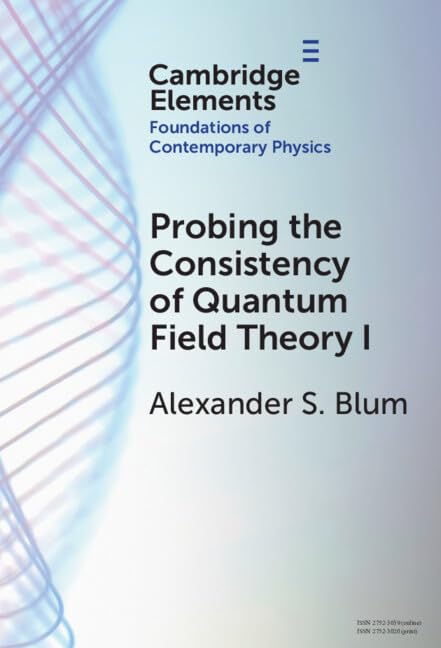
Description
This two‐volume Element reconstructs and analyses the historical debates on whether renormalised quantum field theory is a mathematically consistent theory. Probing the Consistency of Quantum Field Theory I covers the years immediately following the development of renormalised quantum electrodynamics.
It begins with the realisation that perturbation theory cannot serve as the foundation for a proof of consistency, due to the non-convergence of the perturbation series. Various attempts at a nonperturbative formulation of quantum field theory are discussed, including the Schwinger–Dyson equations, Gunnar Källén's nonperturbative renormalisation, the renormalisation group of Murray Gell-Mann and Francis Low, and, in the last section, early axiomatic quantum field theory.
The second volume of this Element covers the establishment of Haag's theorem, which proved that even the Hilbert space of perturbation theory is an inadequate foundation for a consistent theory.
This title is also available as Open Access on Cambridge Core.